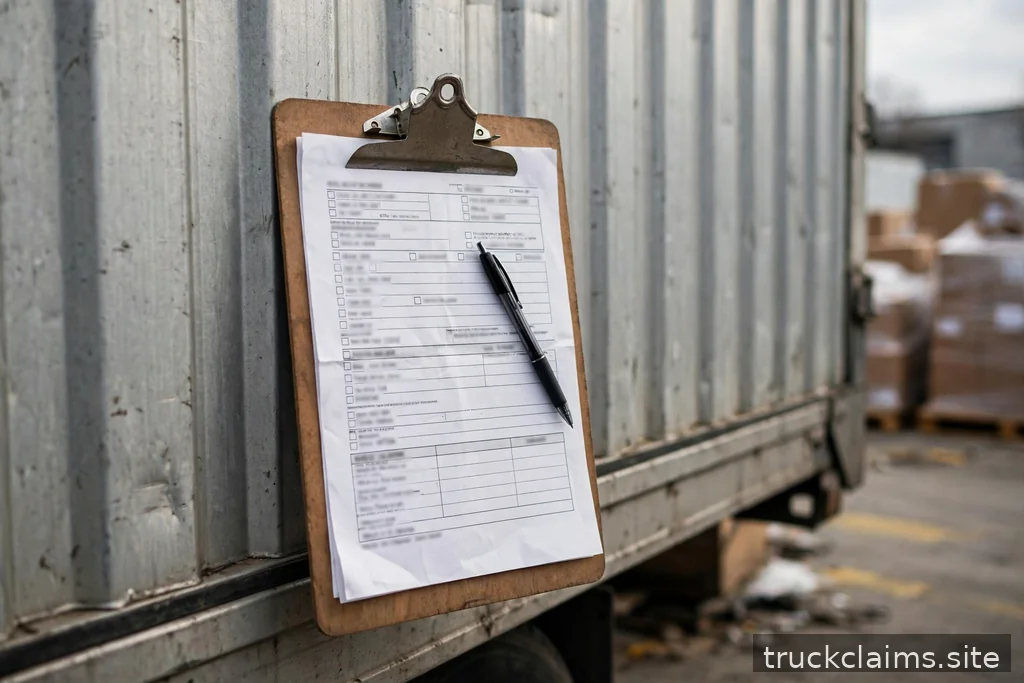
In all of cargo law, no document matters more than the bill of lading. It is three things at once: the contract of carriage between shipper and carrier, the carrier’s receipt for the goods, and the documentary evidence of the goods’ condition at the moment custody transferred. When a cargo claim is filed, the bill of lading is the first document everyone reaches for — the claimant to prove what was shipped and in what condition, the carrier to prove what it agreed to and what defenses apply. Claims are won and lost on this single page more often than on all other evidence combined.
This guide explains the bill of lading’s triple role, what a proper BOL must contain, the common errors that destroy cargo claims, how BOL terms interact with the Carmack Amendment’s timeframes and liability limitations, and the practical disciplines for shippers, carriers, and drivers. If you touch freight, this is the most important page on this site for you.
The triple role: contract, receipt, and evidence
As a contract, the bill of lading sets the terms of carriage: the parties, the origin and destination, the freight charges, and — critically — the incorporated terms governing claims, including the claim-filing period, the suit-limitation period, and any limitation of liability. These terms are not suggestions; under Carmack, they define the procedural rules of any claim, provided they meet the federal minimums. The shipper who never reads the BOL’s fine print has agreed to terms that will control the claim’s deadlines and potentially cap its value.
As a receipt, the BOL documents what the carrier received: the number of packages, the weight, the description of the goods. As evidence of condition, the BOL — particularly with the driver’s notations — records the apparent condition of the freight at shipment. “Shipper load and count” notations, exception notes, and seal numbers all become part of this evidentiary record. In the Carmack prima facie case, the BOL is typically the document that establishes the first element: the goods were delivered to the carrier in good condition. A clean BOL at origin plus damaged goods at destination is the classic foundation of a winning cargo claim — which is why the notations made at loading deserve the same care as those made at delivery.
What a proper bill of lading must contain
A complete BOL identifies: the shipper and consignee with addresses, the origin and destination, the date, the number of packages and their description (including NMFC class where applicable), the weight, the declared value if the shipper is declaring one, the freight terms (prepaid or collect), any special instructions (temperature requirements, delivery appointments, seal numbers), and the signatures — the shipper (or its agent) tendering the freight and the driver acknowledging receipt. Each field serves the claim: identities establish standing, counts and weights establish quantity, declared value interacts with liability limitations, special instructions establish the standard of care.
The description field deserves particular care. Vague descriptions (“miscellaneous freight”) weaken the evidentiary value of the BOL and invite disputes about what was actually shipped; specific descriptions with piece counts create a record that is hard to challenge. Declared value is the field shippers most often leave blank — and leaving it blank typically means accepting the carrier’s default limitation of liability. If the freight is worth more than the default limit, declare it and pay the higher rate; the incremental freight cost is trivial compared to an uncovered loss. This is a business decision to make at the shipping desk, not a legal argument to make after the loss.
Common BOL errors that lose claims
The most destructive BOL errors, in rough order of claim damage: missing or illegible BOLs (no BOL, no prima facie case — reconstructing the shipment from secondary documents is possible but painful); wrong consignee or shipper information (creating standing disputes about who can even file the claim); inaccurate counts or weights (undermining the quantity evidence the claim needs); “shipper load and count” used as a blanket disclaimer where the driver could and should have verified (courts look skeptically at SLC notations that excuse the carrier from any verification); missing declared value on high-value freight (accepting the default limitation by inattention); and altered BOLs — changes made after the fact without initials and dating, which destroy the document’s credibility entirely.
Drivers: your BOL notations at pickup are evidentiary acts. Note exceptions you observe — damaged packaging, short counts, improper loading — specifically and legibly, and get the shipper’s acknowledgment. “Two pallets visibly leaning, shrink wrap torn on pallet 3, noted at pickup” protects everyone: the shipper knows of the issue, the carrier has documented the pre-existing condition, and the later claim starts from an honest record. A driver who signs a clean BOL for visibly damaged freight has created a problem that will surface months later in the claim file, usually at the worst possible moment.
How BOL terms interact with Carmack
The BOL is where Carmack’s abstract rules become concrete obligations. The nine-month claim period and two-year suit period are federal minimums; the BOL sets the actual periods (commonly exactly at the minimums). The liability limitation — if any — lives in the BOL or the incorporated tariff, and its enforceability turns on whether the notice-and-opportunity requirements were satisfied through the BOL process. The BOL may also designate the claims filing address, specify documentation requirements, and incorporate arbitration or forum provisions.
This interaction means the BOL must be read as a legal document before the claim, not during it. When a loss occurs, the first analytical step — after preserving the evidence — is to pull the BOL and extract: the claim-filing deadline, the suit deadline, the liability limitation and whether declared value was stated, the designated claim recipient, and any special procedures. Our Carmack Amendment guide explains the federal framework these terms operate within, and our cargo claims 101 guide walks through the filing mechanics the BOL terms govern.
Electronic bills of lading
Paper BOLs are increasingly supplemented or replaced by electronic bills of lading — created, signed, and stored digitally through transportation management systems, mobile apps, or EDI. Electronic BOLs carry the same legal weight as paper when properly implemented, and they offer real advantages for claims: timestamps, GPS-stamped signatures, attached photos, and centralized storage that does not depend on a driver remembering to turn in paperwork. A BOL with pickup photos attached is a dramatically stronger evidentiary document than a paper form with a smudged signature.
The disciplines transfer directly: completeness of fields, accuracy of counts and descriptions, declared value decisions, and exception notations all matter identically in electronic form. The new considerations are system reliability (what happens when the app fails at a remote shipper with no signal — have a paper backup procedure), data retention (ensure BOL records are retained well beyond the claim-filing periods), and authenticity (electronic signature processes should be defensible if the BOL’s validity is challenged). The medium has changed; the document’s triple role has not.
Practical disciplines for every party
For shippers: complete every field accurately, declare value deliberately on high-value freight, photograph the loaded and sealed trailer, verify the driver’s notations before they leave, and retain BOL copies in a system you can search — not in a filing cabinet organized by hope. For carriers: train drivers on BOL notation as an evidentiary skill, audit BOLs for completeness, retain them centrally with retention beyond the longest applicable claim period, and ensure the tariff or terms incorporated by the BOL actually provide the notice-and-opportunity the liability limitation requires.
For drivers: treat the BOL as the legal document it is. Read it before signing. Note exceptions specifically. Never sign for counts you did not verify unless the BOL accurately reflects “shipper load and count” and you genuinely could not verify. Keep your copy — the driver’s copy of the BOL has resolved more roadside and claim disputes than any other single paper in trucking. And for everyone: when a claim arises, the BOL is the first document into the file and the last one out of the analysis. Everything else corroborates; the BOL establishes.
Frequently asked questions
What if there is no bill of lading for my shipment?
A claim is still possible but significantly harder — the BOL’s triple role must be reconstructed from secondary evidence: rate confirmations, dispatch records, emails, testimony. Courts can find that a carriage contract existed without a formal BOL, but the evidentiary foundation is weaker at every step. Never ship without one.
Can the carrier change the BOL after I signed it?
Not unilaterally in any way that affects your rights. Legitimate corrections happen (a corrected weight, for example) but should be initialed and dated by both parties. Unilateral post-hoc alterations destroy the document’s credibility and can constitute spoliation if done after a claim arises.
Does “shipper load and count” let the carrier off the hook?
Not automatically. SLC notations are legitimate where the driver genuinely could not verify the count (sealed trailer loaded by the shipper, for example), but courts examine whether the notation reflects reality or is a blanket disclaimer. A driver who watched the loading and signed SLC anyway has weakened the notation considerably.
How long should I keep bills of lading?
Well beyond the claim periods — several years at minimum. Cargo claims can surface late (concealed damage), related disputes can extend timelines, and the BOL is also a business and tax record. Digital storage makes long retention essentially free; there is no reason to discard them.
The bill of lading decides cargo claims because it is the claim’s foundation three times over: the contract that sets the rules, the receipt that proves the shipment, and the condition evidence that starts the liability case. Complete it accurately, declare value deliberately, note exceptions specifically, read its terms before you need them, and keep it forever. In cargo law, the party with the better bill of lading usually has the better claim — make sure that party is you.