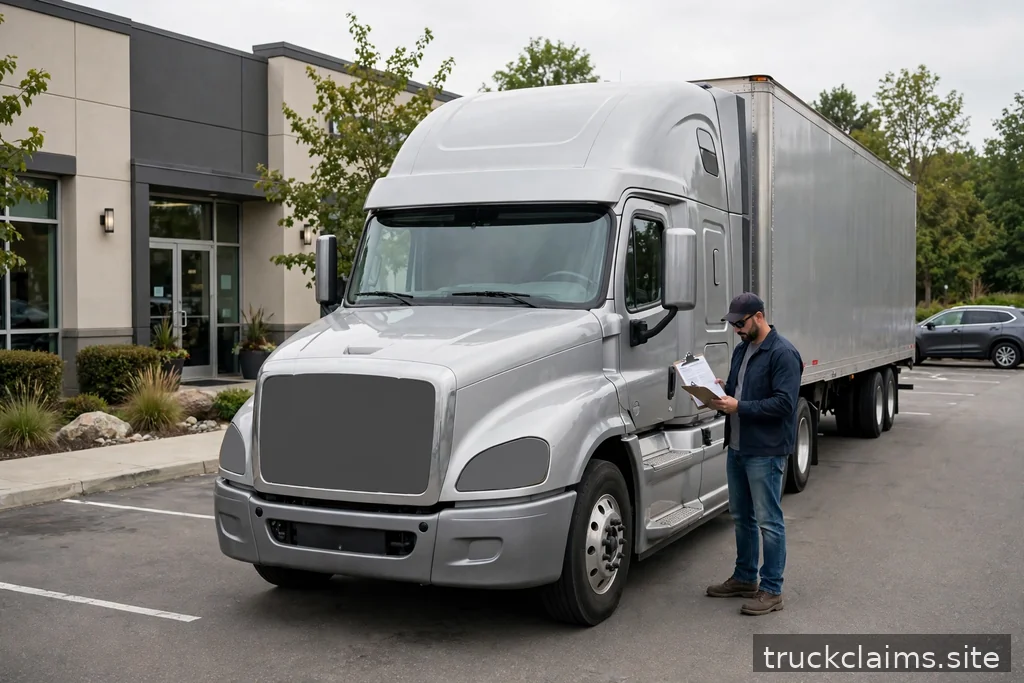
Filing a truck insurance claim can feel overwhelming, especially in the hours after an accident when you are dealing with a damaged rig, a disrupted schedule, and a long list of people who need answers. But the process itself follows a predictable sequence, and knowing that sequence in advance is the single biggest advantage you can give yourself. Most delays in truck claims do not come from complicated policy language — they come from missed steps early on: a notification that went out a day late, photos that were never taken, or a document the adjuster asked for twice because nobody kept a copy the first time.
This guide walks you through the entire process from the moment of the incident to the final settlement check, in the order things actually happen. It is written for truck owners, fleet managers, and drivers — the people who have to do the work — not for insurance professionals. Every step includes what to do, why it matters, and what typically goes wrong when it is skipped. As with everything on this site, this is general information, not insurance or legal advice: your policy language and your state’s rules always control.
Step 1: Secure the scene and handle immediate safety
Before any claim exists, there is an accident scene, and your first obligations are to people, not paperwork. Check for injuries and call emergency services if anyone is hurt. Move vehicles out of travel lanes only if it is safe to do so and local law permits it; in many states you are required to move to the shoulder for non-injury crashes, but never move a vehicle if doing so would put anyone at risk. Set out warning triangles or flares — federal regulations require commercial drivers to place warning devices within ten minutes of stopping on a roadway, and doing this protects both people and your later claim, because it shows you took reasonable care.
Once the scene is safe, start the documentation clock. Take wide photos of the whole scene before anything is moved, then close-ups of damage to every vehicle involved, skid marks, debris fields, road conditions, traffic signs, and weather conditions. If you have a dashcam, preserve the footage immediately — note the time and date, and save a backup copy the same day, because many cameras overwrite old footage within days. Write down the names and badge numbers of responding officers and ask how to obtain the police report. These first thirty minutes produce evidence you can never recreate later, and adjusters consistently rank early scene documentation among the strongest predictors of a smooth claim.
Step 2: Notify your insurer promptly
Almost every commercial truck policy requires prompt notice of a loss — often phrased as “as soon as practicable” — and late notice is one of the most common reasons claims run into trouble. Call your insurer’s claims line as soon as the immediate situation is under control, ideally the same day. Have your policy number, the date, time, and location of the incident, a brief factual description of what happened, and the names of the other parties ready. You do not need to have all the answers; the first call is about opening the claim and getting a claim number, not about proving your case.
Write down the claim number, the adjuster’s name and direct contact information, and the date and time of the call. Ask three questions on this first call: what is my claim number, who is my assigned adjuster, and what documents do you need from me first. If your policy was placed through a broker or agent, notify them too — a good broker will advocate for you if the claim stalls and will make sure notices go to every carrier that might owe coverage. Keep your account of the incident factual and brief at this stage; speculation about fault or the extent of damage can be quoted back to you later.

Step 3: Notify the other parties who need to know
Your insurer is not the only party that needs prompt notice. If you lease your truck to a motor carrier, notify the carrier’s safety or risk department — the carrier’s insurance may be primary for certain losses, and your lease agreement almost certainly requires you to report incidents. If you are a carrier with your own authority, notify your safety director and preserve the driver’s post-accident file. If cargo was involved, notify the shipper or broker, because cargo claims run on their own strict clock under federal law and late notice can kill a cargo recovery entirely.
Do not notify the other driver’s insurer with a recorded statement or a detailed account at this stage. You can exchange basic contact and insurance information at the scene — that is required in most states — but save the substantive conversation for later, after you understand your own coverage. For a deeper breakdown of exactly who gets told what and in which order, see our guide on who to notify after a truck accident. The order matters: your own insurer first, then the parties contractually entitled to notice, and everyone else only with basic facts until you have guidance.
Step 4: Gather your core documents
The adjuster will ask for a predictable set of documents, and having them ready before the first substantive conversation shortens the claim by weeks. Start with the police report (or the report number and the agency to request it from), photos and video from the scene, the driver’s commercial license and medical card copies, the truck’s registration, your insurance policy declarations page, and any tow or storage invoices. If there were injuries, keep medical records and bills organized separately but ready — medical documentation follows its own rules and timelines.
For the truck itself, pull maintenance records for at least the last year, the most recent inspection reports, and the driver’s hours-of-service logs or ELD data for the day of the incident. Adjusters ask for these because they are checking two things at once: the facts of the loss and whether any policy condition — like a maintenance or driver-qualification requirement — affects coverage. Our full truck claim documentation checklist lists everything an adjuster is likely to request, so you can assemble the file once instead of responding to piecemeal requests for a month.
Step 5: Work through the adjuster’s investigation
After the claim is opened, an adjuster investigates: reviewing your documents, inspecting the truck, possibly taking a recorded statement, and contacting the other parties and witnesses. Your job during this phase is to be responsive, organized, and consistent. Respond to requests within a day or two, send documents in labeled batches rather than one-off emails, and keep copies of everything you send. If the adjuster schedules a vehicle inspection, make sure the truck is accessible and that you or a knowledgeable representative is present — inspections done without the claimant’s input are where misunderstandings about pre-existing damage tend to start.
You will likely be asked for a recorded statement. You are generally expected to cooperate with your own insurer, but you are entitled to know the ground rules first: you can ask what topics will be covered, you can take time to prepare, and you should answer only what is asked, factually, without guessing. Our guide to recorded statements explains your rights in detail. If anything about the investigation feels off — repeated requests for documents you already sent, long silences, or pressure to accept a quick settlement — start a written log of every interaction with dates and names.
Step 6: Review the settlement offer carefully
When the investigation wraps up, the adjuster presents a settlement offer or a coverage decision. Do not accept the first number reflexively. Ask for the offer in writing with a breakdown: what is being paid for the truck, for the cargo if applicable, for loss of use or downtime, and what is being deducted — deductible, depreciation, betterment, or salvage value. Compare the repair estimate against at least one independent shop estimate; adjuster estimates and shop estimates disagree routinely, and the gap is negotiable with documentation.
Understand what you are signing. A property-damage release typically closes only the property portion of the claim, but some releases are drafted broadly enough to close everything, including injury claims you may not have fully evaluated yet. Read every word, and if the release mentions bodily injury or “all claims,” pause and get professional advice before signing. An illustrative example: on a $20,000 repair bill with a $2,500 deductible and no fault assigned to you, the starting math is $17,500 before any adjustments — but betterment deductions, depreciation on older components, and disagreements over labor rates can move the final number, which is why the written breakdown matters more than the headline figure.

Step 7: Follow up in writing until the claim closes
Claims rarely close themselves. After each conversation with the adjuster, send a brief email confirming what was discussed and what happens next: “Per our call today, you will send the revised estimate by Friday and I will provide the second shop quote by Wednesday.” This creates a paper trail that keeps the file moving and protects you if the claim is reassigned to a new adjuster — which happens often — because the new adjuster inherits a written record instead of starting from zero.
Set calendar reminders for every promised deadline, and if a deadline passes without the promised action, follow up the next business day. Polite persistence is the most underrated claim skill there is. Keep every document until at least a year after the claim closes, including the final settlement breakdown and the signed release. If the claim involves injuries, keep records longer — your state’s statute of limitations for injury claims sets the real retention horizon, so keep injury-related records at least until that window closes.
Frequently asked questions
How soon after an accident must I file a truck insurance claim?
Most policies require notice “as soon as practicable,” which in practice means the same day or within a few days. Waiting weeks without a good reason gives the insurer an argument that the delay prejudiced its investigation. File early even if you do not yet know the full extent of the damage — you can supplement the claim later.
Can I file a claim if the accident was partially my fault?
Yes. Your own collision or physical-damage coverage responds regardless of fault, subject to your deductible. For the other party’s damages, fault allocation affects what you can recover from them, but it does not prevent you from filing. Comparative-fault rules vary by state, so the same accident can produce different outcomes in different jurisdictions.
Should I get my truck repaired before the adjuster inspects it?
No — not before the insurer has had a reasonable opportunity to inspect. Emergency measures to prevent further damage (tarping, towing to a secure lot) are expected and reimbursable, but permanent repairs before inspection give the insurer grounds to dispute the damage. Photograph everything before any emergency work is done.
What if the other driver has no insurance?
Your uninsured/underinsured motorist coverage, if you carry it, is designed for exactly this situation. Report the uninsured status to your insurer promptly and to the police. Some states also have victim compensation funds, but your own UM/UIM coverage is usually the primary path.
Filing a truck insurance claim is a process, not an event: secure the scene, notify promptly, document thoroughly, cooperate with the investigation, scrutinize the offer, and follow up in writing. Do those six things well and you will avoid the vast majority of the problems that turn straightforward claims into long ordeals. For the next level of detail on any step, work through the related guides linked above — and if you want a quick sense of how deductibles and fault affect the math, try the Claim Payout Illustrator on our homepage.