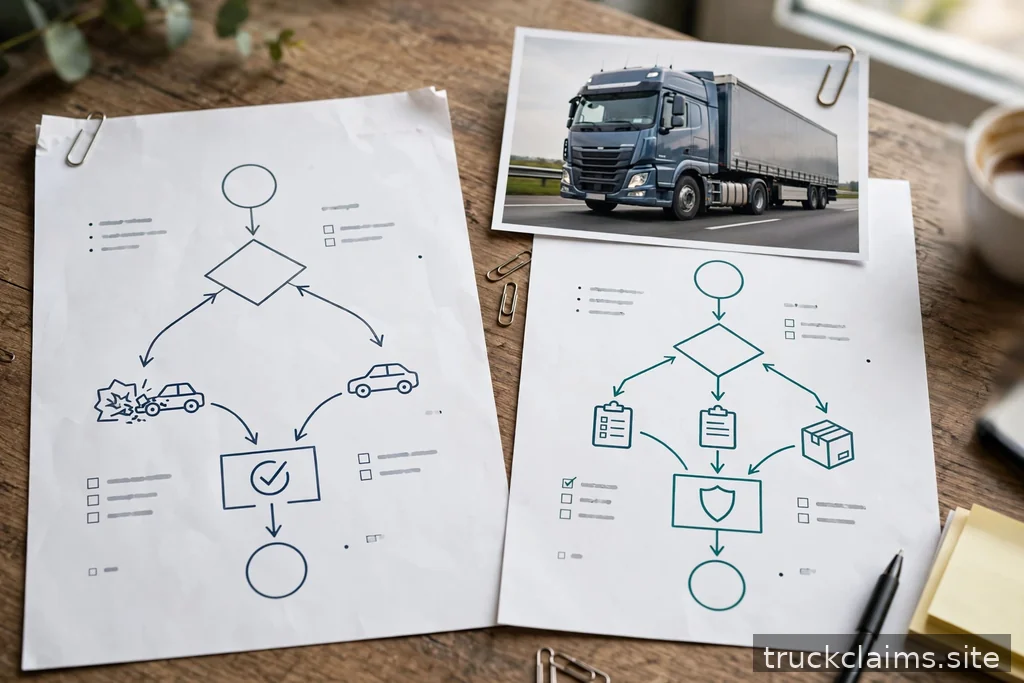
After a truck accident, you will hear two phrases that sound like insurance jargon but describe completely different paths to getting paid: first-party claim and third-party claim. A first-party claim is a claim you file against your own insurance policy — your collision coverage for your truck, your cargo coverage for your load. A third-party claim is a claim you file against someone else’s insurance — typically the at-fault driver’s liability policy. The same accident can generate both, they follow different rules, and confusing them is one of the most common ways claimants leave money on the table or create problems for themselves.
This guide explains each type in plain language: what it covers, how the process works, what the insurer owes you in each role, and how the two interact when both are in play. Understanding the distinction also helps you communicate more effectively with adjusters, because the adjuster handling your first-party claim and the adjuster handling the third-party claim against the same policy have different obligations to you — and knowing that changes how you negotiate.
First-party claims: claiming against your own policy
A first-party claim asks your own insurer to pay for your losses under the coverage you purchased. The most common first-party truck claims are collision or physical-damage claims for your tractor or trailer, cargo claims under your motor truck cargo policy, and uninsured/underinsured motorist claims when the at-fault party cannot pay. You paid premiums for this coverage, and the policy is a contract — the insurer’s duty to you is defined by that contract plus your state’s insurance regulations, which typically impose duties of good faith and fair dealing.
The first-party process is usually faster than the third-party process, for a simple reason: your insurer does not need to investigate whether its own policyholder (you) was at fault before paying your collision claim — fault is largely irrelevant to your own physical-damage coverage. You pay your deductible, the insurer pays the covered loss above it, and the claim moves. The trade-off is that first-party coverage is limited to what you bought: if you carry a $2,500 deductible and $100,000 in cargo coverage, those numbers cap your recovery regardless of what the loss actually cost you.
Third-party claims: claiming against the at-fault party’s policy
A third-party claim asks someone else’s insurer — the liability carrier for the at-fault driver — to pay for the harm their policyholder caused you. Here fault is everything: you must establish that the other party was negligent and that their negligence caused your damages. The insurer owes you no contractual duty of good faith the way your own insurer does; its duty runs to its policyholder, and its adjuster’s job is to protect its policyholder by paying you as little as the facts allow.
Third-party claims can recover things your own policy might not cover, such as the full value of your losses without a deductible, loss-of-use or downtime beyond your policy’s limits, and — where the law allows — damages for things like diminished value. But they are slower and more adversarial: the adverse insurer will investigate fault, may dispute the extent of your damages, and has no obligation to move quickly for your benefit. Liability limits also cap recovery — if the at-fault driver carries only the state minimum, that minimum may not cover a serious truck loss, which is where your own underinsured motorist coverage comes back into the picture.
The practical differences that matter most
The distinction shows up in five practical ways. First, fault: irrelevant to your own collision claim, central to a third-party claim. Second, deductible: you pay it on a first-party claim, but there is no deductible when you recover from someone else’s liability policy. Third, speed: first-party claims typically resolve faster because the insurer is contractually bound to its own policyholder. Fourth, the duty owed to you: your insurer owes contractual good faith; the adverse insurer owes you essentially nothing beyond what the law requires. Fifth, what you can recover: first-party recovery is capped by the coverage you bought; third-party recovery is capped by the at-fault party’s limits and by what you can prove.
These differences drive strategy. When your truck is damaged and the other driver is clearly at fault, many claimants file with their own insurer first — getting the truck repaired quickly under their collision coverage — while separately pursuing the at-fault party for the deductible and any uncovered losses. This is often the fastest path back on the road. Preparing for the adjuster’s inspection applies to both paths, since both insurers will want to inspect the damage.

When to file both after the same accident
Filing both a first-party and a third-party claim after the same accident is common and entirely legitimate — they are not double recovery, because each covers different ground or because one reimburses the other. The classic pattern: you file a collision claim with your own insurer to get your truck fixed now, and you (or your insurer through subrogation) pursue the at-fault driver’s insurer for reimbursement of what was paid plus your deductible. You end up whole once, not twice — the law prevents double recovery for the same loss, and the insurers sort out who ultimately bears the cost between themselves.
There are situations where filing both is not just useful but necessary. If the at-fault driver’s limits are too low to cover your losses, your underinsured motorist coverage fills the gap — but only after the adverse policy pays its limits. If fault is disputed, having your own claim moving forward protects you while the liability fight plays out. And in cargo situations, the cargo owner may pursue the carrier (a third-party claim from the carrier’s perspective) while the carrier pursues its own cargo insurer — parallel tracks that our cargo claims guide walks through in detail.
Subrogation: how your insurer gets its money back
When your insurer pays your first-party claim and someone else was at fault, it typically acquires the right to pursue the at-fault party for reimbursement — a process called subrogation. In practice, this means your insurer’s subrogation department (or a vendor it hires) will pursue the adverse insurer to recover what it paid on your claim, including your deductible in many cases. If the subrogation succeeds, you may get your deductible refunded months after the claim closed — a pleasant surprise for claimants who did not know to expect it.
Subrogation also explains why you should not sign away your rights carelessly. If you settle directly with the at-fault party and sign a broad release, you can destroy your own insurer’s subrogation rights, which may violate your policy’s cooperation clause and create a coverage problem for you. Before accepting any payment from an adverse party while your own claim is open, tell your insurer what you are doing. The two claims are connected even when they feel separate, and keeping both adjusters informed prevents the kind of paperwork collision that delays everyone’s money.
Which claim should you file first?
There is no universal rule, but there is a sensible default: file the first-party claim first when you need speed — getting your truck repaired, getting a rental or replacement, keeping your business running — and pursue the third-party claim in parallel for the deductible, uncovered losses, and any damages your own policy does not reach. Your own insurer has contractual deadlines and a duty to you; the adverse insurer has neither, so leading with the claim where you have leverage gets you moving fastest.
The exception is when filing a first-party claim would hurt you more than it helps — for example, if the loss is barely above your deductible and you are worried about your loss history affecting renewal pricing. In that narrow case, pursuing only the third-party claim can make sense. But be honest with yourself about the trade-off: third-party claims take longer, and every week your truck sits waiting for the adverse insurer’s inspection is a week of lost revenue. An illustrative example: with $20,000 in damage and a $2,500 deductible, filing first-party puts $17,500 of repair funding in motion quickly (before adjustments), while the third-party track chases the $2,500 deductible and any downtime the policy does not cover.

How to talk to each adjuster
Adjust your communication to the relationship. With your own adjuster, be cooperative, organized, and thorough — this is a contractual relationship where helpfulness gets rewarded with speed. Provide documents promptly, keep your statements consistent, and use the cooperation to your advantage by asking what the adjuster needs next. With the adverse adjuster, be polite, factual, and minimal: answer what is asked, do not volunteer, do not speculate, and put important communications in writing.
Never let the adverse adjuster record you informally in a “quick chat” — anything you say can be used to dispute liability or damages. And never accept the adverse insurer’s first settlement offer without understanding the full scope of your losses, including downtime, diminished value where recognized, and any injury component. If the adjuster pressures you with a deadline, remember that real legal deadlines are set by statutes, not by adjusters — our guide to claim deadlines explains which clocks actually matter.
Frequently asked questions
Can I file a third-party claim if I was partially at fault?
Usually yes, depending on your state’s fault rules. In comparative-fault states, your recovery is reduced by your percentage of fault; in the few contributory-negligence states, any fault can bar recovery. Your first-party claim is unaffected by these rules — your collision coverage pays regardless of fault, minus your deductible.
Will filing a first-party claim raise my premiums?
It can affect your loss history, which insurers use in pricing. A not-at-fault claim generally has less impact than an at-fault one, and many commercial insurers distinguish between the two. If the loss is small relative to your deductible and the other party is clearly at fault, pursuing only the third-party claim is sometimes the better business decision.
What is the difference between subrogation and reimbursement?
Subrogation is your insurer stepping into your shoes to pursue the at-fault party; reimbursement is your insurer requiring you to pay it back from what you recover from the at-fault party. Both prevent double recovery. Your policy language determines which applies, so read the relevant section before settling with anyone.
Do I need a lawyer for a third-party truck claim?
Not always — straightforward property-damage claims with clear fault often resolve without one. But when injuries are involved, fault is disputed, the adverse insurer is stalling, or the numbers are large, professional guidance usually pays for itself. See our guide on when to get a lawyer involved for the decision framework.
First-party claims use the coverage you bought and move relatively fast; third-party claims chase the at-fault party’s coverage and require proving fault but can recover what your policy does not. File strategically — usually your own claim first for speed, the adverse claim in parallel for completeness — keep both adjusters informed, and never sign a release without understanding exactly which claim it closes.