After a truck accident, paperwork starts multiplying: the police report, the carrier’s internal incident report, possibly a DOT inspection report, the tow company’s paperwork, and more. Claimants often treat these as interchangeable bureaucratic artifacts — just more forms to collect. But each report serves a different purpose in your claim, carries different evidentiary weight, and is obtained through a different process. Knowing which is which lets you prioritize: some you need immediately, some you request and wait for, and some you create yourself.
This guide explains the three reports that matter most — the police crash report, DOT and roadside inspection reports, and the motor carrier’s internal incident report — what each one establishes for your claim, how to get copies, and what to do when a report contains errors. It also covers the reports people forget: supplemental reports, 911 call logs, and witness statements, which can fill gaps when the main reports are thin.
The police crash report: the foundation document
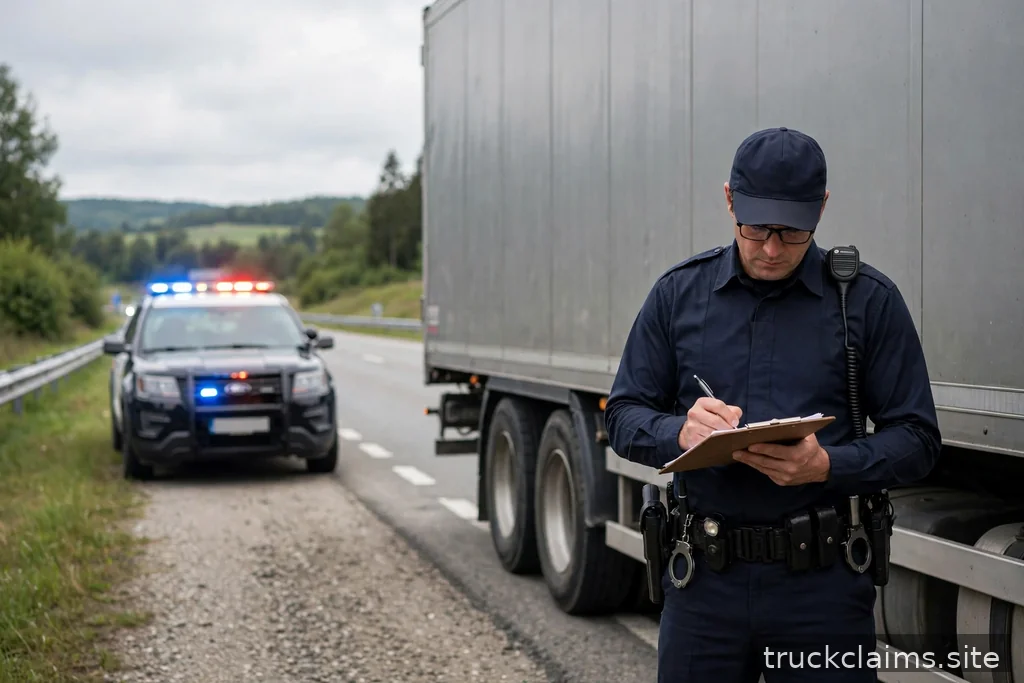
The police crash report is the closest thing your claim has to an official record of the event. Created by a neutral third party within minutes or hours of the incident, it records the date, time, and location, identifies all drivers and vehicles (including DOT numbers for commercial vehicles), notes weather and road conditions, diagrams the scene, records witness information, and includes the officer’s narrative and any citations issued. Adjusters request it in virtually every truck claim, and its absence is conspicuous — a claim without a police report invites extra scrutiny about what really happened.
Get the report number at the scene and ask the officer how to obtain the full report — many agencies now provide them through online portals, while others require a written request or an in-person visit. Full reports typically take one to three weeks to become available. When yours arrives, read it carefully: check names, dates, vehicle descriptions, the DOT number, and the narrative for accuracy. If you find errors, most agencies have a process for requesting corrections or filing a supplemental statement. Do this promptly — a correction made in week three carries far more weight than one requested in month six. Our filing guide covers getting the report number at the scene as part of the first-hour routine.
What a police report proves — and what it does not
A police report is influential but not decisive, and understanding its limits prevents both over-reliance and unnecessary panic. What it proves well: that the accident happened when and where you say it did, who was involved, the basic facts of the scene, and whether citations were issued. What it does not prove: legal fault in any binding sense. Officers assign fault based on a brief roadside investigation, not a trial; their opinion is one piece of evidence among many, and insurers, lawyers, and courts all reach independent conclusions.
This cuts both ways. If the report favors you, do not assume the claim is won — the adverse insurer will still investigate independently. If the report is unfavorable or neutral, do not despair — additional evidence like dashcam footage, ELD data, and witness statements can and do overcome an unfavorable initial report. The report’s greatest value is often not its conclusions but its raw material: the witness list, the measurements, the diagram, and the contemporaneous observations, all captured before anyone had time to shape a story.
DOT and roadside inspection reports
Separate from the crash report, commercial vehicles generate inspection paperwork that can matter enormously to a claim. If a roadside inspection was conducted at or after the incident — increasingly common when a truck is involved in a serious crash — the inspection report documents the vehicle’s mechanical condition: brakes, tires, lights, coupling devices, and any out-of-service violations found. This report can corroborate your maintenance records or, if it finds defects, become the centerpiece of a dispute about whether the truck was roadworthy.
Obtain any inspection report connected to your incident through the inspecting agency, and keep your own copies of all recent inspections in your documentation file. If you are a carrier, your safety department should already be tracking inspection results; if you are an owner-operator, request copies of any inspection conducted on your truck and keep them with your maintenance records. When maintenance is questioned in a claim — and in serious claims it routinely is — a clean recent inspection is powerful corroboration, while a missing one is a gap the other side will exploit.
The carrier’s internal incident report
If you drive for a motor carrier, the carrier will generate its own internal incident report — and if you are the carrier, you should generate one for every incident, no matter how minor. This report is your organization’s contemporaneous record: who was notified and when, what post-accident protocols were triggered (drug and alcohol testing, ELD preservation, vehicle impound), the driver’s statement, photos taken by company personnel, and the initial assessment. Unlike the police report, this one is yours to control, which makes its quality entirely your responsibility.
Write it the same day, stick to facts, and distribute it narrowly — to safety management and your insurer, not broadly around the company. Be aware that internal reports can be discoverable in litigation, so keep them factual and professional: no speculation about fault, no colorful language, no admissions. A disciplined incident report written in the first hours is one of the strongest assets a carrier can have in a disputed claim; a sloppy one, or worse, none at all, is a liability. Fleet managers should treat the incident report as a non-negotiable procedure, not a judgment call.
Supplemental reports and the records people forget
Beyond the big three, several lesser-known records can fill critical gaps. The 911 call log and any recordings establish the exact time of the incident and the first description of what happened — obtainable from the dispatch agency, sometimes for a small fee. Supplemental police reports, filed when new information emerges, can correct or expand the initial report. Tow company invoices and impound records establish the chain of custody for the vehicle. Hospital and EMS records document injuries contemporaneously. And in an era of cameras everywhere, nearby traffic cameras, business surveillance footage, and bystander video can provide views no party captured — but this footage is routinely overwritten within days, so requests must go out immediately.
Witness statements deserve special mention. The police report usually lists witnesses, but officers do not always take detailed statements, especially at chaotic scenes. If a witness saw the accident, ask for their contact information at the scene and follow up within days for a brief written account — even a few sentences in an email, dated and signed. Witness memories decay fast, and a statement taken in week one is worth ten times one taken in month three. Your adjuster can also contact witnesses, but witnesses you identify and preserve yourself are witnesses that do not get lost.

When a report contains errors
Reports contain mistakes more often than people expect: wrong DOT numbers, misidentified vehicles, transposed times, narratives that misunderstand what happened. When you find an error, act quickly and through proper channels. For police reports, contact the reporting agency and ask about the correction or supplemental statement process — many agencies allow involved parties to submit a written supplement that gets attached to the original report. Provide the correction factually and without argument; you are fixing the record, not relitigating the accident.
If the agency will not correct the report, create your own paper trail: a dated written statement describing the error and the correct information, sent to your insurer and kept in your file. The goal is to ensure that anyone reviewing the claim later sees both the report and your timely correction. For errors in your carrier’s internal report, correct them through your safety department with the same factual discipline. And if a report error is material — wrong vehicle identified as at fault, for example — raise it with your adjuster explicitly rather than hoping someone notices; adjusters read hundreds of reports and will not always catch what you would.
How to actually get copies
The practical mechanics: police crash reports are obtained from the responding agency — check their website first, as online portals are now common; otherwise submit a written request with the report number, date, and location. Expect a small fee and a wait of one to three weeks. DOT inspection reports come from the inspecting agency or through your carrier’s safety department. 911 logs and recordings come from the dispatch agency and may require a formal records request. Your carrier’s internal report comes from your safety department — if you are the driver, ask for a copy for your own records.
Start every request early, because reports are slow and claims are not patient. Log each request with the date, and follow up if the promised timeline passes. When reports arrive, read them immediately, check for errors, and file them in your organized claim folder. A complete set of reports, obtained promptly and checked for accuracy, gives your adjuster the foundation to evaluate your claim confidently — and confident adjusters settle claims faster.
Frequently asked questions
What if no police report was filed?
File one if the agency still accepts late reports for your incident type — many do within a set window. If not, build the record yourself: your written account, photos, witness statements, and any 911 or dispatch records. A claim without a police report is harder but far from impossible; it just requires more corroboration from other sources.
Can I get the other driver’s statements from the police report?
The police report typically summarizes what each party told the officer, and you are entitled to a copy of the report as an involved party. Those summaries are useful for understanding the other side’s account early, though they are hearsay summaries, not sworn testimony.
Does a citation in the police report decide fault for the claim?
No. A citation is the officer’s roadside assessment, not a legal determination of civil liability. Insurers conduct their own fault analysis, and citations are just one input. Many claims resolve contrary to the citation when the fuller evidence — video, data, witnesses — points the other way.
How do I correct a police report error?
Contact the reporting agency promptly and ask about their correction or supplemental statement process. Submit corrections factually and in writing. If the agency will not amend the report, create your own dated written correction and provide it to your insurer so the file contains both versions.
Reports are the skeleton of your claim file: the police report establishes the event, inspection reports establish the vehicle’s condition, your carrier’s report establishes your contemporaneous response, and the supplemental records fill the gaps. Get them early, read them critically, correct them promptly, and your claim will rest on a foundation that stands up to scrutiny from any direction.